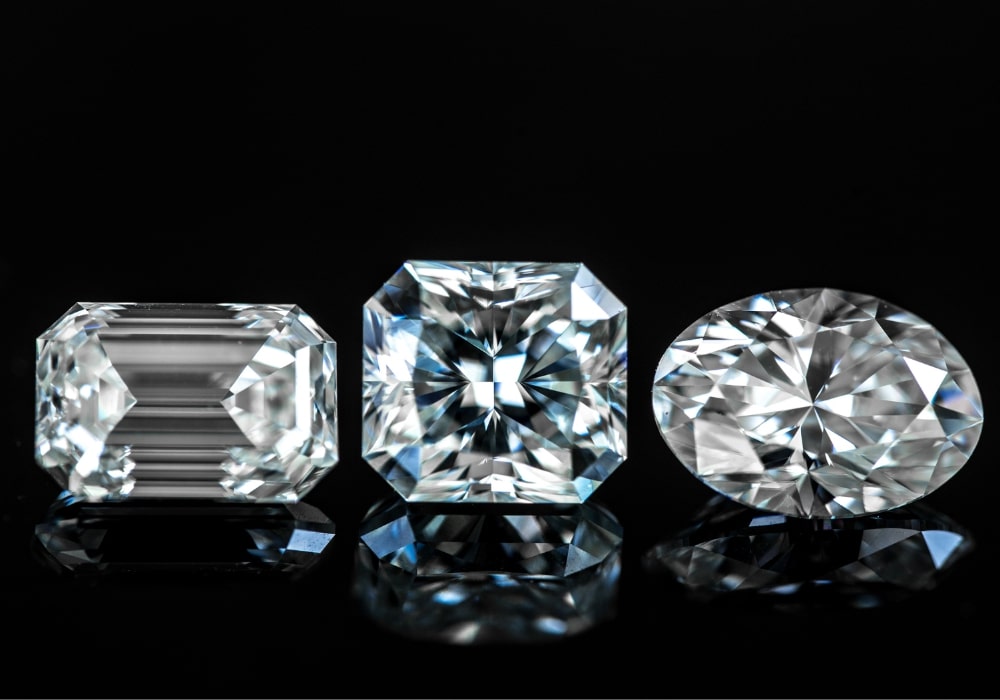
Oval shapes and radiant cuts are the two most popular shapes of the last several years. Since the two are fairly different in appearance, choosing between them could be difficult. We’re here to break down each cut and see how they compare and contrast.
Oval Shape Diamonds:
Although the specific person who cut the first oval-shaped diamond is unknown, we do know that royals wore them hundreds of years ago. However, Lazare Kaplan invented the brilliant cut oval design that we are familiar with today in the 1960s. For the past five years, oval diamonds have been the most preferred shape.
Essentially the elliptical form of the round brilliant cut, ovals are a lovely extended shape with rounded edges. Typically, ovals have 58 facets that are carved to maximize brilliance and light reflection.
Radiant Cut Diamonds:
Henry Grossbard created the radiant cut in 1977. With the brightness of a round brilliant and the shape of an emerald cut, Grossbard aimed to create a new diamond cut. Radiant cuts frequently have beautiful faceting on cut corners and are rectangular in shape.
With 70 facets, radiants are regarded as one of the most dazzling diamond cuts possible; in contrast, other brilliant cuts, such as the oval, only have 57–78 facets. Radiant cuts are quite popular for people who desire the brilliance of a round cut but the shape of an emerald cut, just as Grossbard intended.
Oval vs. Radiant Ratios:
Ovals are naturally elongated shapes, so the width will primarily depend on the ratio you select. Look for a stone with a ratio in the 1:1.3 range if you want an oval that is more compact and circular. These stones will have a ratio above 1.4, towards 1.5, if you’re searching for a thinner, longer oval. A ratio of about 1.4 would be a good compromise.
There are really just two choices for radiant cuts: elongated and square or rectangular. In order to get an elongated radiant cut, a ratio of 1:1.3 to 1:1.4 would be suitable. But if you want a radiant that is more square cut, go for a ratio that is little above and closer to 1:1.
Oval vs. Radiant Cut Comparison:
Ovals and radiants are not very comparable in look; radiants are rectangular in shape with cut corners, but ovals are the elliptical adaptation of a circle.
Although radiant cuts and oval shapes are both dazzling cuts, radiants have 70 facets while ovals only have 58. To optimize sparkle, both cuts are elongated brilliant cuts with comparable faceting patterns.
Because of their elongated design, ovals typically appear larger than their actual carat weight, even if radiants may have more brightness.
Oval vs. Radiant Quality Comparison:
Ovals’ wide surface area makes it easy for them to display color. We advise choosing an I color or above as a result. However, ovals are excellent at concealing flaws, therefore we can confidently advise choosing a SI2 oval that is (eye-clean).
We may confidently suggest a color graded as low as J and an eye-clean SI2 for clarity because radiant cuts are excellent at concealing color and impurities.
As a reminder, not all diamonds, inclusions, and/or grading labs are created alike, therefore it is always a good idea to view each one in person for evaluation.